


Here's the short version: read my full article on Substack for the complete breakdown.
New Orleans made me realize that contradiction isn't chaos, it's character. I joke that I have multiple personalities. A wild, playful, fearless side that wants progress and momentum, and another side that craves peace, consistency, and nurture. For a long time, I thought I had to mediate between them, to organize the chaos. New Orleans showed me these contradictions could not only coexist but thrive together and be unapologetic about it.
Seeing how New Orleans embraced its duality, encouraged me to do the same and even see it as a superpower.
That realization changed how I see myself, and how I designed my home. Not curated into perfection, but layered, lived-in, and a space where I don't have to perform. The kind of place, and way of being, where others feel permission to do the same.
Mixing Old and New
I mixed old and new because that's how New Orleans lives. Different eras, different influences, different materials, all in conversation. Mixed metals instead of matched ones. Color used confidently, not sparingly. Maximalism not as excess, but as soul. Every choice rooted in the idea that a home should feel collected; expressive, not restrained. I like to say, nothing makes sense and yet it all makes sense. It's chaotically cohesive and tells a story.
Celebration as a Way of Life
In New Orleans, celebration isn't reserved for milestones. It's a way of life. Music spills into the street not because something extraordinary is happening, but because being alive is the occasion. Food isn't just nourishment, it's comfort, heritage and generosity. Strangers talk to each other. They dance together. They linger. The city invites participation. It doesn't ask you to watch from the sidelines.
And the architecture makes all of that possible.
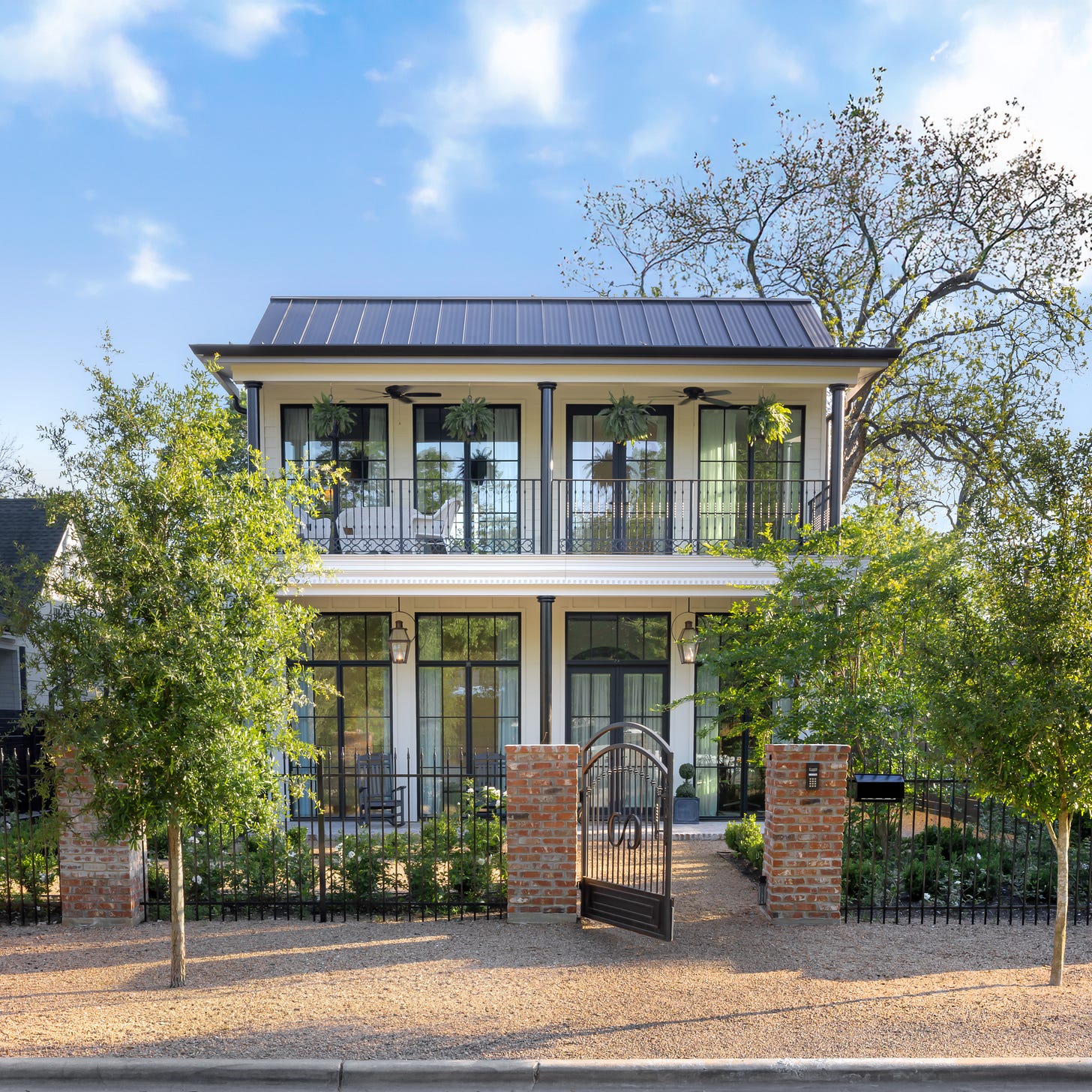
Buildings are designed for hosting. Porches and stoops are architectural invitations turning strangers into neighbors. Courtyards turn inward, creating moments of pause and surprise with hidden worlds meant for gathering. High ceilings lift heat and energy upward, allowing rooms to feel expansive, even when full of people, music, and conversation. Iron fences define boundaries without shutting people out. Archways slow you down, marking transitions, or as I like to say, transport you. Even the way materials age (brick softening, iron rusting, paint peeling) all feels intentional. The city wears its history openly. Nothing is erased. Everything is layered.
That ethos became the blueprint for my home. I designed for gathering.
Values Over Aesthetics
Let me be clear, this house isn't inspired only by New Orleans aesthetics. It's mostly inspired by New Orleans values.
- The belief that joy is essential.
- That beauty can be gritty.
- That history should remain visible.
- That celebration is a daily practice.
- That community doesn't happen by accident. It's built into the space.
At its core, this home carries forward New Orleans' greatest architectural value: hospitality as structure. Spaces are designed for people to gather, for music to travel, for food to anchor conversation. The bar, the courtyards, the porches, the open interior flow all assume joy as a default condition.
Hospitality as the Point
How I host, how I entertain, how I bring people together here. All of it flows from that same philosophy. Life is better in good company and one conversation can change your life. Making people feel welcome isn't a detail; it's the point.
In that way, this home is not just a structure, it's a way of being. A living room for connection. A setting for stories. A place where contradictions are allowed to dance instead of cancel each other out.
And every time people gather here, laughing, talking, staying late, feeling seen, I know I got it right.
When you're searching for a home, whether it's your first or your forever, I believe the neighborhood and community you choose matters just as much as the floor plan. The best homes aren't just built; they're felt.
Thinking about your next move in Austin?


