



Here's the short version: read my full article on Substack for the complete breakdown.
My protest packet structure has helped hundreds of Austin homeowners successfully reduce their property taxes.
I've successfully personally protested every property I've owned. I've sat in on dozens of hearings, so I know exactly what works and what doesn't. More than once, appraisal board members have told me my protest was the best they've seen. The inner nerd in me is very proud of this!
Here's the truth: the fastest way to lose is to be emotional and disorganized. The fastest way to win is to be factual, strategic, and prepared.
This process isn't random. It isn't personal. And it's not about arguing.
It's about evidence.
This is your complete guide to protesting property taxes in Texas for 2026. While this guide focuses specifically on the Travis County Appraisal District (TCAD) protest process in Austin, the strategies apply statewide, whether you're in Dallas, Houston, San Antonio, or anywhere in Texas.
Texas Property Tax Protest 2026: What You Must Know Before Filing
Before we go deeper, here are the non-negotiables every Texas homeowner needs to know before filing a property tax protest in 2026:
Deadline: The Texas property tax protest deadline for 2026 is May 15, 2026 OR 30 days after your Notice of Appraised Value is mailed, whichever is later.
Check Your Mail: Your Notice of Appraised Value contains your Property ID and PIN number. You cannot file online without that PIN. Otherwise, you have to email to request it and it's a pain.
File Online First: Always start by filing through TCAD's eFile system. Many cases resolve informally before a formal hearing.
Evidence Wins. Emotion Loses. Comparable sales, property condition documentation, and unequal appraisal data matter. Opinions do not.
Protest Both Market Value AND Unequal Appraisal. This gives you two avenues of argument. Everything below will show you exactly how to execute this properly.
How TCAD and Texas Appraisal Districts Value Your Property
The Travis County Appraisal District (TCAD) determines your home's market value as of January 1, 2026.
That date controls everything.
Your property is valued based on what it would have sold for on January 1, 2026, not what the market is doing today.
Your strongest comparable sales should reflect the market leading up to that date, ideally sales that closed between January 1, 2025 and December 31, 2025. Sales after January 1, 2026 may support your case if they clearly reflect conditions that already existed on January 1, but pre-January 1 closings are the cleanest evidence. I would even argue comparable sales that sold closest to January 1, meaning October–December, could be weighted stronger than comps sold earlier in the year.
This is where homeowners go wrong: pulling whatever recent sale looks helpful. Your comps must support the January 1 valuation date.
TCAD separates your value into:
- Land Value
- Improvement Value (the structure)
- Total Market Value (land + improvements)
Knowing which part to challenge, and how, is where strategy comes in.
Important: Why Protesting Land Value Rarely Works in Austin
In many Austin neighborhoods, land value is applied by neighborhood code and lot size ranges. It is often relatively static within similar zoning and subdivision groupings.
You are not realistically going to win a protest arguing that your land should be worth dramatically less than identical neighboring lots unless:
- Your lot is significantly smaller
- You back to a highway or commercial use
- You have topography limitations
- You have drainage/floodplain issues
Focus primarily on improvement value unless there is a true land difference.
5 Insider Tips to Lower Your Texas Property Taxes (Most Homeowners Miss These)
These are the details that quietly win cases.
1. Use Your Purchase Price or Home Appraisal as Evidence
Texas is a non-disclosure state. Sale prices are not automatically reported to the appraisal district.
That means TCAD does not necessarily know what you actually paid for your home.
If you purchased your home in 2025 (or even the past 2–3 years) for less than TCAD's 2026 appraised value, and market conditions haven't significantly increased, your purchase price can be your strongest evidence.
You can submit:
- Your closing disclosure
- Your executed contract
- A lender appraisal from your purchase
If you have a third-party professional appraisal (even from a refinance), you can use it, especially if it clearly outlines how the appraiser arrived at their valuation.
Important: Only use this strategy if it helps you. If you paid more than TCAD's value, don't introduce it.
If you purchased three years ago and have made no significant upgrades, and the market has softened, you can argue: "The home has not materially improved since purchase. Based on market conditions, value has not increased beyond my purchase price."
Hard numbers carry weight.
2. Double-Check TCAD for Property Record Errors
Pull your property record from the TCAD website at traviscad.org (Travis Central Appraisal District).
Verify:
- Square footage
- Year built
- Garage count
- Pool listed correctly
- Bathroom count
- Condition rating
If TCAD shows 2,450 sqft and your home is 2,280 sqft, that alone impacts value.
Clerical errors are one of the easiest wins.
3. Verify Your Texas Homestead Exemption Cap (10% Rule)
If you have a homestead exemption in Texas, your appraised value (not market value) cannot increase more than 10% per year. In 2026, the school tax homestead exemption increased to $140,000, which means additional savings on top of your protest. For a deeper dive into how this works and how to apply, check out our guide to the Austin homestead exemption.
Check:
- Last year's appraised value
- This year's appraised value
If the increase exceeds 10%, that is not discretionary. It must be corrected.
4. Use Unequal Appraisal: Compare Your Neighbor's Appraised Value
This is where "Unequal Appraisal" becomes powerful.
Go to traviscad.org and search your neighbor's address.
You can see:
- Market value
- Appraised value
- Property details (size, year built, etc.)
If your neighbor's home is similar in size, age, and condition and appraised lower, that's usable evidence.
Photos are your strongest support here.
If you're close with your neighbor, document:
- Similar kitchens
- Similar finishes
- Similar lot size
- Similar condition
If their home is equal or inferior in condition and appraised lower, that strengthens your case.
The appraisal district will not raise your neighbor's value because you used it as a comparison. Protests can lower or maintain value, not increase it as retaliation.
The more informed a neighborhood is, the stronger everyone's position becomes.
5. Propose a Specific, Data-Backed Property Value
Don't just ask for "lower."
Propose a specific number backed by data.
If comps support $510,000, ask for $510,000.
Credibility matters. Reasonable adjustments are easier for appraisers to justify internally.
Why Property Classification Matters for Your Texas Tax Protest
Under Texas Property Tax Code §23.01 and TCAD appraisal standards, property must be appraised based on its legal classification and market category. That means your comparable sales must match your property type.
In Travis County, common classifications include:
- Single-Family Residential (detached)
- Condominium (including A-unit / B-unit regimes)
- Townhome
- High-Rise Condominium
- Low-Rise Condominium
- Duplex / Multi-Family
- Manufactured Housing
You must compare like with like.
If your property is legally a condominium, even if it looks like a detached house, it must be compared to other condominiums. A detached single-family home is not an appropriate comp because land ownership, allocation, and valuation methodology differ.
For example: An A-unit condo on 0.08 acres cannot be compared to a detached single-family home on 0.08 acres. The detached home owns its land outright. A condo's land value is allocated differently under TCAD's mass appraisal system.
When property types don't match, the evidence is typically given little weight by the appraisal review board.
Match the legal property type first. Everything else comes after that.
Step-by-Step: How to File a Property Tax Protest in Travis County (2026)
Step 1: File Form 50-132 (Notice of Protest) with TCAD
File via Travis County Appraisal District's (TCAD) eFile portal using your Property ID and PIN.
Check:
- Incorrect Market Value
- Unequal Appraisal
Incorrect Market Value means you are arguing that TCAD overestimated what your property would have sold for on January 1, 2026. Your evidence will focus on comparable sales, property condition, and market data supporting a lower value. This is the most common protest argument.
You are saying: "Based on comparable sales, my home's fair market value is lower than what TCAD determined."
Unequal Appraisal means your property is being appraised higher than similar properties, even if overall market values seem consistent. Here, you're comparing your appraised value to the appraised values of similar homes in your neighborhood.
You are saying: "Homes similar to mine are appraised lower. My value should be aligned with them."
In Travis County, I almost always recommend checking both if applicable. It gives you two legal pathways to reduction.
There is no penalty for selecting both, as long as you can support your argument with evidence.
Step 2: Wait for Your Informal Review (Settlement Offer)
Most Travis County property tax protest cases first go through an informal settlement review.
This is your best opportunity to lower your property taxes without going to a formal ARB hearing.
Step 3: Prepare Your Protest Evidence Packet Before the Informal Review
Do not wait until the formal hearing.
Upload evidence early.
Building Your Property Tax Protest Evidence Packet (What Actually Wins)
Let me show you how I structure a winning protest packet.
In my own protests, I organized:
- Cover letter with summary of the requested value
- Comparable properties with condition analysis
- Spreadsheet with side-by-side comp comparisons
- Map view of where comparable properties are located
- Photos of subject vs comps
That level of organization makes it easy for the appraiser to justify reducing your value.
You are not fighting them. You are helping them justify an adjustment.
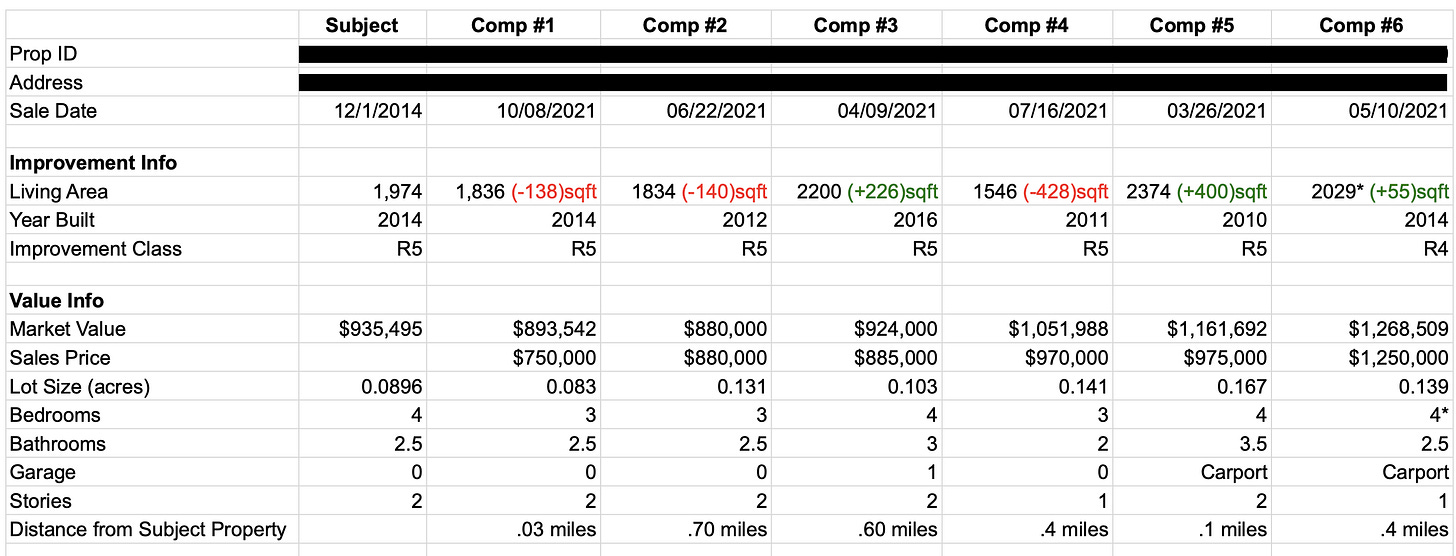
How to Choose Comparable Sales for Your Property Tax Protest (Think Like an Appraiser)
1. Distance
Ideally within 0.5 miles. Same subdivision, or same condo building, is strongest. Appraisers prioritize neighborhood code consistency.
2. Square Footage
Stay within 10–15% of your home's size. If your home is 2,000 sqft, look for roughly 1,800–2,200 sqft. Large size gaps weaken credibility.
3. Year Built
Within 10 years if possible. Construction quality, materials, and design standards matter. A 2005 build and a 2022 build are not viewed the same, even if square footage matches.
Strategic nuance: If your home is newer but basic builder-grade, and you find a slightly older home that was fully renovated to the studs with high-end finishes, that property may demonstrate superior condition, meaning your value should not exceed it.
4. Condition & Feature Adjustments
Take photos of EVERYTHING that is wrong: cracked foundations, water stains on the ceiling, peeling paint, old roof, outdated bathrooms, broken tiles.
Take interior photos of your rooms to compare to the comps. Show similarities. Highlight differences.
Appraisers adjust for condition. You should too.
How to Present Your Property Tax Protest Argument (With Sample Scripts)
Be concise.
Example: "Based on three comparable sales within 0.5 miles that closed before January 1, 2026, homes similar in size and condition sold between $420,000 and $435,000. My home lacks a garage and has original finishes. I believe a fair market value closer to $425,000 is appropriate."
If arguing unequal appraisal: "Three homes in my subdivision with similar square footage are appraised $30,000 lower. I am requesting alignment with those values."
How to Protest Property Taxes on Unique Properties (When Comparable Sales Don't Exist)
Some properties simply don't have easy matches:
- Ranch properties
- Lake homes
- Custom builds
- Oversized homes in modest neighborhoods
- Rare condo layouts or premium views
- Buildings with no recent comparable sales
This is where you shift from strict matching to valuation logic.
1. Expand the Search Area
If your subdivision has no recent sales, expand carefully to adjacent neighborhoods. But explain why the area is comparable.
For example: If an adjacent neighborhood consistently sells for more because it feeds into a higher-rated school district, has more parks, or is closer to downtown, that matters. Location premiums are real.
If your neighborhood typically trades at a discount compared to the adjacent one, make that distinction clear.
2. Break Down Feature Value (Not Just Square Footage)
Square footage matters, but not all square footage carries the same value.
Kitchens and bathrooms typically cost more per square foot than bedrooms or secondary living areas. Buyers place more value on functional, high-use spaces than on sheer size.
So if you need to use a comparable that is larger than your home, you must explain why the extra square footage does not justify a significantly higher value.
For example: If your home is 2,000 sqft and a nearby comp is 2,400 sqft (20% larger), but the kitchens are similar in size and finish, the bathroom count is the same, and the additional space is a secondary living room or oversized bedroom, you can argue that the extra 400 sqft does not proportionally increase market value.
An additional bedroom does not automatically add $40,000–$50,000 in value. A larger game room does not necessarily justify a dramatic price difference if the core features (kitchen, bathrooms, primary suite) are comparable.
The key is this: Just because a home is bigger does not mean it is more valuable.
When selecting comps that don't perfectly match square footage, explain why the difference in size does not represent equal difference in market desirability. That's how you keep the focus on value, not just size.
3. Use Appraised Value Comparisons More Heavily
When sales are limited, lean more on unequal appraisal. Find homes with similar square footage, similar construction class, and similar lot characteristics. Even if not identical, show consistency in how similar homes are being valued.
4. Argue Functional or External Obsolescence (Location, Layout, Noise)
If your property has an unusual floor plan, is an oversized home for the area, has limited natural light, highway noise, power lines, or limited lake access: those are legitimate marketability factors.
Ask the question appraisers ask: "Would a typical buyer pay the same for this as that?"
If the answer is no, explain why.
Final Thoughts: Win Your 2026 Texas Property Tax Protest
The 2026 TCAD protest process rewards preparation.
If you file on time, use accurate comps, present organized evidence, and stay factual and strategic, you dramatically increase your chances of a reduction.
This guide reflects how I approach real estate as a whole: data-driven, organized, and strategic. Understanding valuation isn't just helpful during tax season. It's critical when you're buying, selling, renovating, or investing in Austin. For more on how property taxes and appraisals work in Texas, see our guide to understanding property taxes and appraisal.
I don't protest taxes for the public.
But I do equip my clients with the same protest packet framework and market analysis tools I use myself. If you'd like access to my protest packet template and comp structure, you can download it here:
And if you're thinking about buying or selling in Austin, this is exactly the kind of valuation strategy you want your realtor to understand.
I help my clients make educated decisions giving them the most leverage in negotiating the best deal. That includes pricing homes correctly, negotiating strategically, and understanding how TCAD's valuation impacts long-term ownership costs.
If you're planning to buy or sell a home in Austin in 2026, or just want a sharper understanding of your property's true market value, let's talk.
Because in this market, knowledge isn't optional. It's leverage.
Chloe Chiang, Austin Realtor | chloechiang.com
Thinking about your next move in Austin?


