


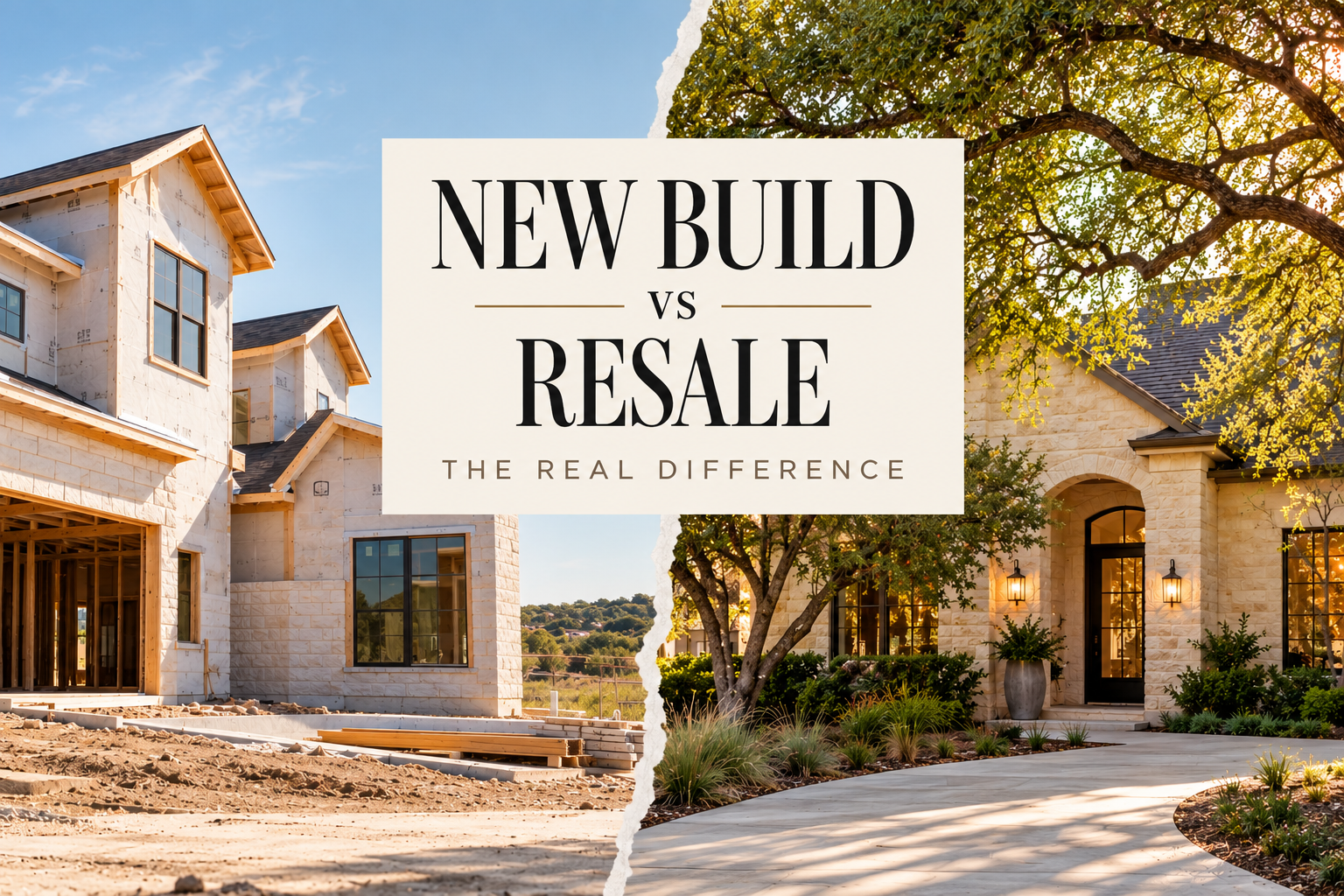
Every new-build brochure leads with a base price. Almost nobody pays it. Between the lot, the design center, the tax bill and the contract, a new home and a five-year-old resale at the same sticker can land six figures apart. Here's how I compare the two for buyers. Cedar Park is the case study, because the tradeoff there is hard to miss right now.
The base price is a starting point
A builder's base price covers the standard plan on a standard lot with standard finishes. Then the real spending starts:
- The lot. Corner lots, cul-de-sacs and greenbelt backs carry upcharges, and they go first.
- Structural options. The extra bedroom, the extended patio, the third garage bay. Each one is priced on its own. They add up fast.
- The design center. Flooring, cabinets, counters and lighting. At the luxury end, this is where budgets break. Set your ceiling before you walk into the studio. I think about this as Design-Forward Equity: put the money into the rooms the next buyer will pay for, the kitchen and the primary bath. Skip the upgrades nobody notices at resale.
- What's in the box. Around Austin, builders generally include window coverings, fencing, full landscaping and appliances. A resale may not come with appliances, and window coverings are a 50/50 shot. Price that in when you compare.
Read the full tax rate, not the city rate
Newer subdivisions around Austin sometimes sit in special districts that add to the property tax bill. Ask the builder for the total tax rate on the specific lot, every taxing entity included. Run your monthly payment on that number. Same price, very different tax bill. It happens all the time.
Then plan for year two. In year one, a new-build buyer generally pays property tax on the unimproved lot value only, because the house wasn't finished when it was assessed. In year two, the bill resets to the full value of the house. A resale buyer pays on the full house from year one. Budget for the year-two payment from day one, or the second-year escrow bill will be a shock.
Builder incentives are published. Resale is a negotiation.
Builders use rate buydowns and closing cost credits to move inventory, and they often publish them, sometimes right on their website. They're worth real money, especially when rates are high. They also change month to month and get thinner as a community sells out. Fewer homes left means less reason to deal. Get every incentive in writing on the contract.
Resale works differently. There's no incentive menu. You make an offer that includes what you want, whether that's a credit, a repair or a closing date, and the seller decides whether to agree. It's a completely different process, and it's where a good offer strategy earns its keep.
The contracts are different too
Builder contracts are written by the builder, and they favor the builder. They generally can't be amended. What they hand you is what you sign. Resale contracts in Texas use the state's standard forms, which are designed to protect both buyer and seller, and special provisions can be added to fit the deal. Know which one you're signing before you fall for the model home.
When new wins and when resale wins
Most buyers compare sticker prices. I compare what I call Lifestyle-Adjusted ROI: the full monthly cost, plus what you have to buy on day one, measured against how the house changes your week. A cheaper base price that adds 20 minutes to every drive isn't cheaper.
New wins when you want a specific floor plan, warranties, energy-efficient systems and nothing to fix for a few years, and the incentives close the gap on price.
Resale wins when you want mature trees, a finished yard and a contract you can shape.
The case study: Cedar Park in 2026
Cedar Park is almost built out, which makes the tradeoff easy to see. The city's median sale price has held around $500,000 for three years, about $505,900 in 2024 and $511,250 in 2025 according to MLS-based market reports, and most of what trades is resale. New construction sits at the edges:
- Entry level: Pulte's Whitestone Preserve offered townhomes in the high $300Ks, and Brohn Homes' Cross Creek offered detached homes from about the $400Ks to the mid $500Ks. Both were reported near sellout this spring.
- Luxury: Toll Brothers opened Crestline at Brushy Creek in March 2026 with homes from about 2,800 to over 4,700 square feet, starting in the mid-$900,000s. Toll's Hidden Creeks at Lakewood Park lists base pricing from the high $800,000s.
- The gap: almost nothing new between roughly $550K and $950K inside Cedar Park.
That gap is where most of my Cedar Park conversations start. A buyer at $700K there is shopping resale, or driving a few miles north to new communities in Leander, or stretching to a Toll home and holding the line on upgrades. Three different answers. The right one comes down to the full monthly number.
Before you sign with a builder
- Bring your agent to the first visit. The sales rep works for the builder. Most builders require your agent to be there when you first register.
- Ask how many lots are left in the section you want, and which ones.
- Inspect anyway. Get a pre-drywall inspection and a final one. New doesn't mean perfect.
- Confirm the school assignment for the exact address with the district. In Cedar Park, for example, homes are split between Leander ISD and Round Rock ISD, and boundaries change. I'll give you the district facts for any address. I don't rank schools.
Weighing two homes right now?
If you've got a new build and a resale on the table, send me both. I'll run the real monthly numbers side by side.
Sources: Toll Brothers community announcements for Crestline at Brushy Creek (March 2026) and Hidden Creeks at Lakewood Park; NewHomeSource builder listings; MLS-based Cedar Park market reports (2024 to 2026). Pricing, incentives and lot availability change month to month, so confirm current details with each builder.
Thinking about your next move in Austin?


