


Austin-Bergstrom is in the middle of the largest expansion in its history, and I don't think enough people talking about Austin real estate are paying attention to what a $5 billion airport bet actually means for this city and for property values. Here's where our airport has been, where it is now, and where I think the growth is headed next.
The Handshake
Think back to the first time you came to Austin. Maybe it was SXSW, a wedding (/ a bachelor party), or maybe you flew in to visit a friend for what was supposed to be one weekend. Somewhere in that trip, there was a moment you decided you wanted to live here.
Here's what I'd bet. Somewhere in that same trip, there was also a moment at the airport, arriving or leaving, where it already felt less like a city you were visiting and more like a place you were coming home to.
The plane lands. The doors open. And before anyone's said a single word to you, the city has already told you something about itself.
There's a French anthropologist named Marc Augé who spent decades studying places like this. He called airports "non-places," a term for spaces built purely for passage, not belonging. Essentially no culture or identity. Nowhere anyone is actually from. You move through them as fast as you can and you feel nothing, because they're designed for you to feel nothing. Highways. Hotel chains. Most airports in this country. Anywhere built to be forgotten the second you leave it.
Austin is a city that doesn't believe any space should feel anonymous. Not a dive bar, not a taco truck, not a backyard show, and it turns out, not an airport either.
So when I tell you Austin-Bergstrom is in the middle of the largest expansion in its history, I don't want you to hear "more gates." I want you to hear: our handshake is getting a lot more important, and the city is treating it that way.
Here's where it's been, where it is, and where I think it's going.
Where It's Been
Most Austinites have never heard the actual origin story, and it's a good one.
Before this was ABIA, it was Bergstrom Air Force Base. Air Force One used to land here. Lyndon Johnson flew in and out of it on his way to the ranch. By the late 1970s, the city's old municipal airport, Mueller, was maxed out, and Austin spent over a decade trying to negotiate a shared civilian-military airport at Bergstrom. It took until 1993 for voters to actually approve the bonds to build something new, and 1999 for the doors to open on what we fly through today.
The thing to note here is this airport exists because a city voted to bet on its own growth before the growth had fully arrived. Austin didn't wait to be big enough to deserve a real airport. It built one first and grew into it.
We're about to do that again.
Where It Is Today
Here's the number that made me want to write this whole series. This isn't an estimate, it's a whole damn study- and I nerded out on it. TxDOT ran an economic impact analysis in 2018, using 2017 data, built with FAA-standard methodology. AUS generated $7.6 billion in economic activity that year and supported more than 74,000 jobs. That's up 212 percent from 2010, when the number was $2.4 billion. Passenger traffic told the same story, from 8.69 million people in 2010 to 13.89 million by 2017. Today it's over 21 million, on an airport that was originally designed for 11.
That's a city that outgrew its own front door and is now racing to catch up.
So Austin is spending $5 billion to add 32 new gates, with ten-year lease commitments already signed by Southwest, United, Delta, American, Alaska, FedEx, and UPS. And this isn't happening in isolation. The Austin Convention Center closed last year for its own $1.6 billion rebuild, reopening in 2029 with nearly double the space, in time for SXSW. Two multibillion-dollar bets on the same city, landing in the same three-year window. You don't do that unless you know you have the capacity to support it.
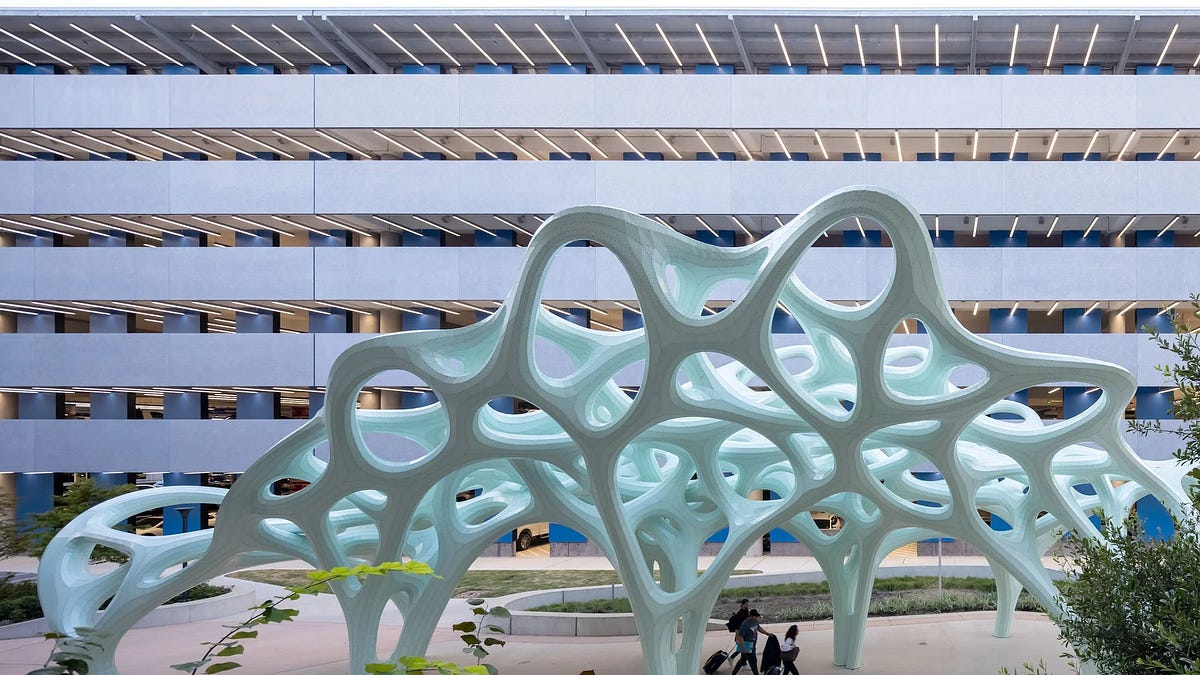
Here's why I think we should actually be excited about this instead of annoyed by the construction. An airport can be the fastest, most efficient non-place in the country, or it can be the first live music you hear, the first breakfast taco you smell, the first unreasonably friendly stranger who says welcome to Austin like they mean it. Every dollar we put into ABIA is a dollar we're choosing to spend making sure a stranger's first ninety minutes in this city feel like Austin instead of feeling like Anywhere, USA. That's the kind of hospitality that makes me proud to be a Texan and Austin resident. Y'all know I love the details, and I love coming home to Austin. That's the whole thesis of what makes this city worth visiting in the first place.
And the growth isn't staying inside the terminal. Two massive developments and one of them is double the size of downtown.
The first is The Row, formerly called Velocity, 314 acres and 7 million square feet of mixed use directly east of ABIA. Not a rendering. The first apartment building is built and leasing right now, with retail and restaurants underway.
The second is bigger, messier, and honestly more interesting. Locals have started calling a 2,600-acre stretch of land the Dog's Head, because the Colorado River bends around it in a shape that actually looks like one. This summer, City Council voted 7 to 3 to hand it to a developer, with Amazon's robotics division lined up as the first major tenant. It could bring in enough new tax revenue to fund $5.6 billion in infrastructure over the coming decades.
I want to be honest about the part that isn't romantic. Neighbors on the Dog's Head found out about the deal two days before the vote that annexed their land, from a friend who happened to see it on the council agenda. The council member who represents that area voted against the financing plan and told a local reporter, "I feel we could've done better." That matters. A neighborhood finding out about its own future secondhand is a real cost, and I'm not going to pretend it isn't.
One more honest note, and I'll keep it brief because it's more of a callout than a deep dive: not every acre next to a growing airport benefits equally. Homes and land directly under a flight path can actually lose value from the noise, even while commercial and logistics land nearby gains. Del Valle and the corridor south of the airport catch the heaviest overflight. The Row and the Dog's Head sit closer to the edges of that pattern than the center of it, but if you're the kind of person who wants to check before you buy, there are flight noise maps online worth five minutes of your time.
Where It's Going
Here's my actual prediction, and I want to say clearly that this next part is a read, not a fact.
Right now, the main way into that whole southeast corridor runs through Highway 71. Meanwhile, I-35 is being widened and lowered below street level through downtown, and the plan to build public parks and green space over the top of it, the whole "cap and stitch" vision, has lost some of its funding and gotten scaled back. It's not dead. It's genuinely uncertain, and the earliest any of it gets built is 2029.
183 was actually built specifically to give Austin an alternative to I-35 congestion downtown, and it's the one highway that threads through nearly every other highway in this metro. My bet is that as I-35 construction drags on for years, more people start defaulting to 183, and downtown's actual center of gravity starts stretching east, maybe all the way toward Pleasant Valley. I don't have a study to hand you for that one. I have eighteen years of watching where this city's friction builds before anyone else notices it. Plus I bet big on the east side with my own investments and I notice patterns and migrations.
Zoom out further and there's a real economic theory that backs the bigger bet. An urban sociologist named John Kasarda coined the term aerotropolis to describe cities where the airport becomes an actual center of gravity, not just a way in and out. His favorite proof point isn't a massive metro. Memphis, population 1.2 million, built a $29 billion regional economy around a single FedEx hub. Denver is doing something similar right now, actively recruiting development to build directly next to its own airport, with one local planning conversation floating the idea that the airport corridor could eventually rival downtown itself. (I hate Denver, for a lot of reasons but mostly the airport and how far it is.)
For scale, DFW generates $78.3 billion a year and supports 684,000 jobs. Houston's two airports together generate $40.6 billion and support close to 208,000. Austin isn't close to either yet. And none of it, not Austin's expansion, not DFW's, not Houston's, comes out of your property tax bill. All three fund themselves through airport revenue, reserves, bonds, and federal grants. But these are some big numbers that show that airports are big economic revenue generators- maybe this could pay for the damn cap on I-35!
The Thread
I keep coming back to that anthropologist and his non-places. He wasn't wrong about most airports. Most of them really are built to be forgotten. And actually when I think about it, I can't forget some airports because they are so awful. Ever been stuck in the Vegas airport or got lost in Atlanta or had to take that gross train thing in LA? But Austin spent thirty years insisting that even the most ordinary corner of this place should feel like somewhere specific, somewhere warm, somewhere worth remembering. I love our airport- the curation of the dining options, the local artists, even the bathrooms are pretty nice. I'd love some lounges but I'm sure we'll get there.
The airport is the biggest, most literal test of that instinct we've got. It's the handshake before anyone says a word. Every gate we build, every dollar we spend, every stranger who walks off a plane and feels something other than Anywhere, USA, is us deciding, on purpose, what kind of city we want to keep being.
We voted for this once, back in 1993, before we were big enough to need it. We're being asked to believe in it again.
I think we should.
Thinking about your next move in Austin?


