


In Part 1, we saw a 26.4% drop in Austin prices turn into a 9.1% drop in the monthly payment which equates to $221 on the median home price. In Part 2, we found Austin’s 199% foreclosure increase was relative to a historically low 2025, when pandemic-era protections were still holding filings down. Today the rate is 1 in 2,000 homes, and the stress sits with a narrow group: 2022 buyers who put 3.5% down.
Somebody who bought in 2022 with a fixed-rate mortgage never got a rate increase. They got an insurance increase, a tax increase, a childcare increase, a health premium increase, and a student loan payment that came back after 3 years. Their mortgage payment is identical to the day they signed.
Their monthly costs went up every single year.
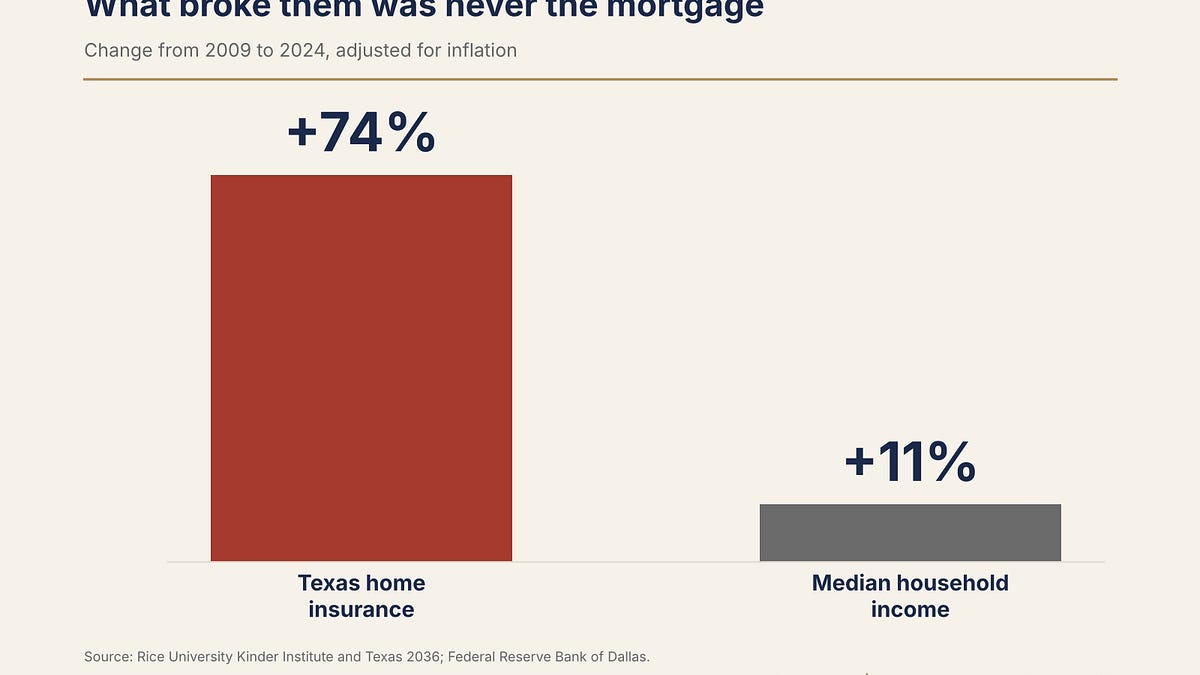
Texas home insurance
Texas home insurance premiums rose 74% from 2009 to 2024, adjusted for inflation. Median household income rose 11% over the same stretch. Premiums now take 4.6% of median household income in the typical Texas county, up from 2.9%. The Dallas Fed found the median Texas homeowner paid 60% more in 2024 than in 2019, double the 30% increase nationally.
Travis County property taxes
Travis County’s effective property tax rate runs 1.65% to 2.07%, an average bill near $10,800. Texas caps homestead appraisal increases at 10% a year, and assessed values lagged during the boom. Many homes are still catching up, so the tax bill can rise in a year the market falls.
Everything around the house
- Texas insurers requested an average 24% increase on 2026 marketplace health plans. A Johns Hopkins study found people with medical debt had a 44% higher risk of housing instability the following year.
- Austin is the most expensive metro in Texas to raise a child, at $24,891 a year.
- Federal student loan payments restarted after a 43-month pause, and more than 3.6 million borrowers have defaulted.
The pattern underneath
Household debt hit $19.1 trillion in the third quarter of 2026, with credit card balances at a record $1.29 trillion. The share of card balances newly falling 90 days behind was 6.87%, a touch below the 7.05% of a year earlier.
Cards and mortgages show the same shape: new delinquencies flat or falling, deep delinquencies rising. A temporary income shock doesn’t look like that. A permanent cost increase does. A job loss gets fixed when you’re rehired. An insurance premium that rose 74% stays where it landed.
What about the Austin tech layoffs?
Every time foreclosures come up, somebody blames tech layoffs. Those cuts hit the people involved hard. They didn’t add up to a regional job loss.
Austin’s unemployment rate was 3.7% in September, unchanged from a year earlier and below Texas at 4.4% and the U.S. at 4.2%. Austin ranked No. 1 among the top 50 U.S. job markets for job growth in 2025, adding 27,200 jobs. Hiring has slowed since, to about 12,900 jobs over the past 12 months, roughly 0.9%. Slower hiring. Still hiring.
Coming in Part 4
So the median price is down, sales are down, and the stress sits with a narrow group of buyers. On Tuesday, the finale: why the market froze, where everybody moved, what changed in November, and what it all means for you whether you own, buy, sell, or wait.
Sources: Rice University Kinder Institute and Texas 2036; Federal Reserve Bank of Dallas; Travis Central Appraisal District; Moon et al., JAMA Network Open, January 2026; SmartAsset; Federal Reserve Bank of New York Q3 2026 Household Debt and Credit Report; Texas Workforce Commission; Opportunity Austin.
Thinking about your next move in Austin?


